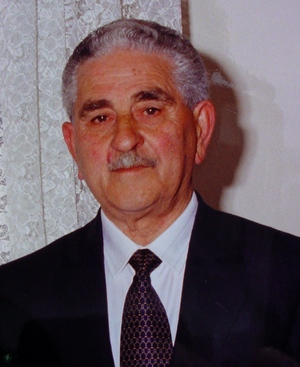
Every
epoch, nevertheless,
introduces
testimonies
of individuals
that have
had a tormented
relationship
with the
"really"
present,
because
overhung
by more
consistent
behavioural
styles to
a past,
at times
next, at
times even
remote,
incompatible
with the
mutability
of the times.
We can say
the same
for those
people who
have anticipated
the future
times with
their ideas
and styles
of life.
We can see
this as
in famous
people just
like Andrew
Chenier,
Robert Brasillach,
Luigi II
of Baviera,
the Princess
Sissi, Hölderlin,
as in the
common people,
unknown
to the more.
The twentieth
century,
particularly,
it has been
prolific
in such
sense, thanks
to temporal
cycles that
have marched
to a speed
faster than
the one
hat characterizes
"the
generational
adjustment".
In this
article
I speak
of a man
that would
have turned
83 years
old on April
23rd 2003.
His name
is Lorenzo
Lavorgna,
one of the
so many
men that
big part
of the life
has lived,
surely the
last eight
five-year
periods,
"out
of his time."
It narrates
the legend
that Sigfrido,
when saw
Hagen, asked
him if he
was friend
or less.
To the affirmative
answer,
serene,
he turned
his shoulders
and Hagen
hurted him
mortally.
I like to
begin from
this episode
of the "Volsungsaga",
both to
make free
to those
distant
northern
roots that
unite all
the Lavorgnas,
both immediately
to center
the most
pregnant
aspect of
the personality
of Lorenzo:
his incapability
to see the
evil in
the man,
the strong
need to
confer trust
to the people
and the
great suffering
in to discover
that the
human mind
is able
to also
give birth
to perfidy
and wickedness.
I remember
a man that
always had
the smile
on the lips,
able to
a peaceful
speech,
fruit of
continuous
reflections,
and liable
of quiver,
at times
surely excessive,
only for
the strong
love that
fed for
his family.
The first
image that
unravels
me to the
mind is
a smiling
man that,
in a cold
morning
of over
forty years
ago it turns
on the smoke
to avoid
the danger
of cold
in his vineyard,
and, with
the help
of a fed
crowd of
unbelievers
collaborators,
race among
the rows,
imparting,
with calm
and without
being upset,
the directives
about the
right way
to use the
candelottis
furnished
by the Montecatini
and experimented
for the
first time.
Many years
later, reflecting
on that
episode,
I became
me account
that the
possible
loss of
the crop
had broadly
been outclassed
by the cheerful
enthusiasm
sprung by
that event,
that unintentional
protagonist
of a turn
epochal
saw him
in the guardianship
of the agricultural
products
from the
climatic
adversities.
Man of other
times, to
whom the
essence
"spiritual"
of every
contingent
reality
assumes
a bigger
importance
than the
"practical
consistence",
destined
to produce
profit and
wealth.
If he had
devoted
to the busy
studies,
Lorenzo
Lavorgna,
would have
become never
an economist
or an engineer;
perhaps
an architect,
surely a
poet.
Its deeper
joy consisted
into "to
give"
and for
him, the
problem
of the choose
between
being and
possession,
didn't have
sense. What
a joy the
to feel
to be said
that its
wine was
"insuperable"!
Man of other
times, he
would have
found very
nice to
live in
the Six
hundred
French Courts,
as Vatel,
the big
master of
ceremonies
of the Prince
de Condé,
able to
invent only
admirable
things for
the taste
of the beautiful
one, to
surprise.
Lorenzo
Lavorgna
and St.
Lorenzello.
How to synthesize
in few lines
the deep
love that
tied him
to his roots?
Will it
be enough
to affirm
that it
turned continuously
his 23 years
of permanence
to Caserta
into a sort
go and come,
often without
real reason,
only to
“live”
his born-country?
Will it
be enough
to remember
that one
of the most
beautiful
days of
his life
it was hat
in which
his daughter
Annalisa
confided
him that
Felice,
the future
husband,
and she
had decided
to live
in St. Lorenzello?
I should
certainly
speak of
the fifties
years, those
of the great
ferments,
of the Cooperative
for the
electrification
of the rural
zones, of
the juicy
lunches
prepared
by that
authentic
strength
of the nature
that answers
to the name
of Giuseppina
Federico,
the indomitable
and pugnacious
wife, the
lighthouse
of a whole
life, made
still brighter
when the
complexity
of the human
took stories
the upper
hand on
the dreams.
It would
be too much
complex
to go down
in the details
and it will
be enough
to say that
he has always
acted with
the heart,
from true
"romantic
of other
times",
to which
is be liked
reciprocated
with equal
love its
love. But
the changing
of the times
and the
sudden transformation
of the society
toward the
forms of
the modern
cynicism,
provoked
him more
than few
sorrows.
Luckily
in 1966
a new ray
of sun radiated
the ancestral
house of
"Cancello
Massone"(Rural
place of
St. Lorenzello)
Annalisa,
his daughter
born with
the seed
of the maturity,
when Lorenzo
had already
completed
the 46°
year of
age.
They seem
graven on
the stone
his words,
when the
girl risked
him in the
local political
life: "Be
careful,
my daughter.
Always behaved
seriously,
but try
to not take
too seriously
everything
around,
otherwise
you will
suffer a
lot."
The wisdom
of the old
age had
given birth
to the warning
towards
the beloved
daughter,
of which
it knew
well the
extreme
limit over
which its
ethics would
never have
pushed her,
also at
the cost
to suffer
heavy oppressions
according
to the iron
laws of
the politics.
Lorenzo
Lavorgna
has departed
for the
great trip
on April
10th 2003
and today
it rests
to few meters
from the
other child,
Gino, that
broke the
heart to
the family
few days
before his
eighteenth
birthday,
and from
the first-born
Pasqualina,
that didn't
succeed
in gathering
the warmth
of her first
sun, when
it came
to the world
in 1950.
A lot of
people have
rendered
him the
extreme
regard,
to testimony
of an affection
that crosses
the confinements
of the perceptible
one and
it wedges
in those
spheres
of the conscience,
exclusive
heritage
of the historical
memory of
everyone,
within which
is allowed
to enter
anybody.
In so many
they had
not seen
him for
many years,
because
the old
lion had
chosen for
a while
the almost
absolute
withdrawal
in his abode.
In so many,
especially
among the
more young
people,
have wondered
and have
asked who
was, in
reality,
Lorenzo
Lavorgna.
Everyone
has furnished
his own
perception
of the man,
fortified
by the most
intense
memoirs,
tied up
to anecdotes,
ancient
friendship,
images of
a past that
it seems
distant,
despite
can contain
him in the
slim puff
of an event
that calls
life, always
too much
short, for
everybody.
Lorenzo
Lavorgna
was a good
and mild
man, certain,
but he was
also a splendid
icon of
that man
that represents
the antithesis
of the enlightenment
one, whose
ethical-moral
decadence
is under
the eyes
of everybody,
because
the irrational
nature of
the human
being has
not been
moulded
by the wish
rationalist
affirmed
him in the
18°
century
yet, and
it will
be never
it, being
alone able
to produce
the monster
called "hypocrisy",
bleak and
affected
with gangrene
regulator
of the human
stories.
Lorenzo
Lavorgna
didn't know
what wanted
to say "hypocrisy"
and he has
always abjured
every form
of appearance,
rowing against
current,
therefore,
in comparison
to the laws
that govern
the world.
I write
this memory
with the
broken heart
and a knot
to the throat
that breaks
the voice,
while I
am reflecting
on what
I could
reply if
someone
had to ask
to me who
has been,
in reality,
Lorenzo
Lavorgna.
How many
things I
could say,
drawn by
my memoirs,
from those
of other
people's,
from his
stories.
How to do,
however,
to find
the correct
words? Everything
I could
say I would
never succeed
in transmitting
his real
essence
that could
be gathered
only in
his deep
look, in
the brief
sentences
and, in
pregnant
way even
more, in
the sound
of his voice,
stupendous.
Everything
it would
be always
few, insufficient,
incomplete.
A wind of
suggestive
visions
would overwhelm
me denying
me every
descriptive
possibility.
Better the
silence,
then, that
silence
that he
loved so
much and
that it
was, at
same time,
so eloquent!
The silence,
yes, or
perhaps
to answer
with simple
words, to
pronounce
turning
the look
to the sky
and trying
to smile
as he was
able to
do: "He
was my father."